Thứ Ba, 6 tháng 3, 2018

Survival of an old Lady - Chapter Three


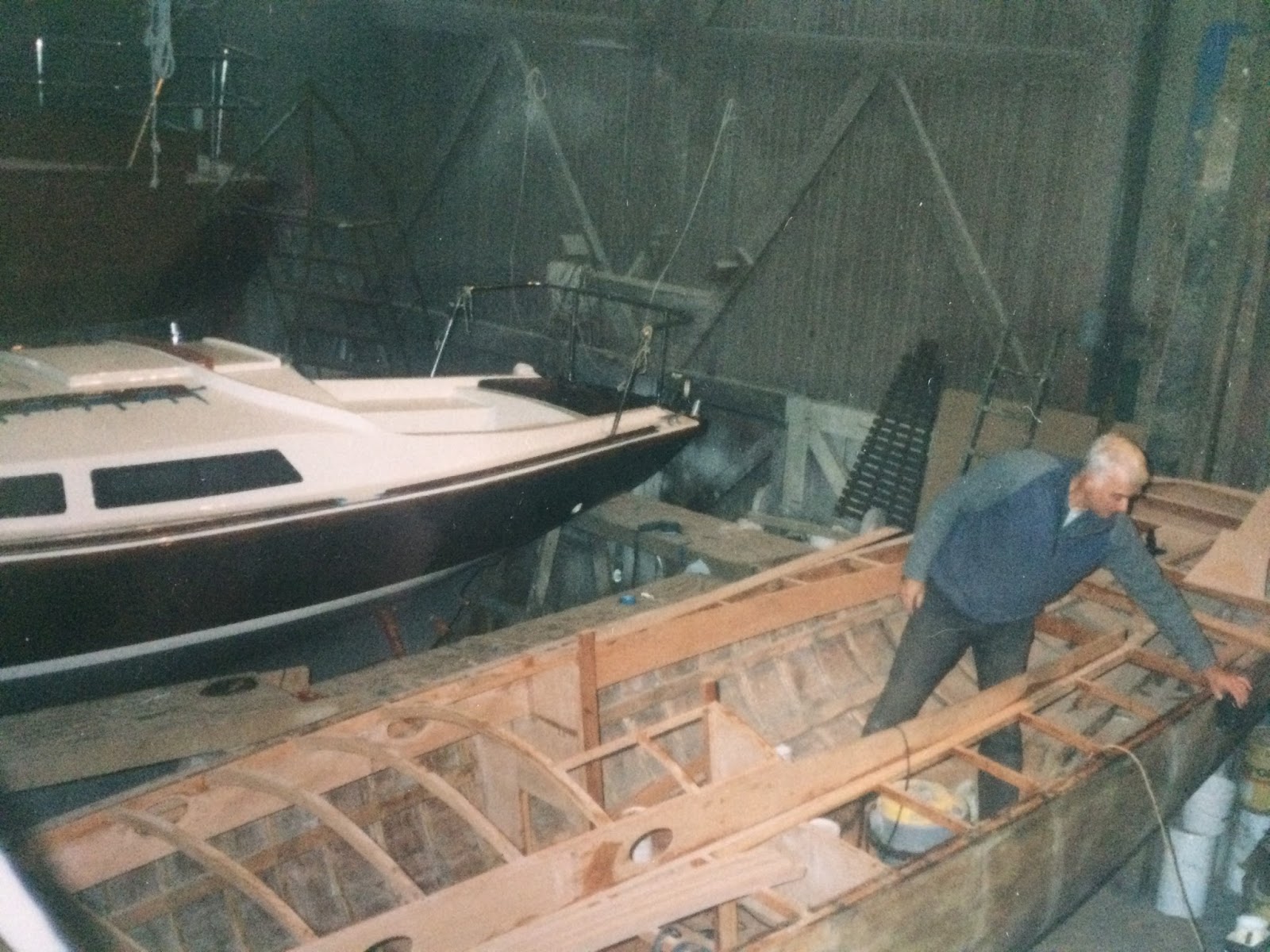
With Stroma near home in Argyll I could speed up progress by working at weekends rather than weekdays when the normal job allowed.

The first task was building the cabin sides, from marine plywood that was later given a good outer surface of mahogany from a beautiful big plank that I had come across.

Decisions had to be taken about how closely to follow the design. Alfred Mylne had drawn curved corners at the front end of the cabin, but McGruers had built them sharp, starting a debate on which was authentic, with Mylne winning.

The cabin roof proved challenging with the curvature flattening forward.


Quality control inspection

Sonas in the background, being worked on for the new owner
Cabin structure nearly complete

The original main beam with the Official Number was kept

Reunited with her keel

Ready for fine joinery work
As work proceeded individual components became more intricate and demanding to make, but also more fun.

I spent a lot of time wondering how to replace the original rudder stock trunk, which seemed to have started out in life as a piece of iron drainpipe. It had rusted almost through and could have sunk the ship in seconds had it collapsed underway. I couldn't find a satisfactory replacement and was worried about the tendency of plastics to behave in strange ways afar prolonged exposure to water. Eventually I decided to make a tube from thin staves of Western Red Cedar, barrel-fashion, coated with woven roving and then protected from any glancing blows by a stout ash timber glued on the forward side.

partial bulkheads replace original iron posts

chart storage


the correct way to build a watertight hatch, like a Roman fort with two walls


to be continued... Click here

Survival of an old lady - Chapter Two - ends in evil thoughts!


The first step in any restoration is to discover how much you've let yourself in for. Stripping off the deck revealed that most of the deck beams were either burst or rotten.

The stem was in a disastrous condition. It would have been made from a piece of oak selected for its curve, but the yacht was damaged at Hunters Quay sometime soon after the War when a ferry ran into her and a couple of feet had been replaced at the top. The original and new sections were both seriously rotten, quite a common problem when you consider how susceptible oak is to fresh water.

There's a special sort of archaeology involved in rescuing old boats. While received wisdom says that the ancients always produced dovetailed joints we found that the deck beams had in fact been lodged in notches in the shelf with each held in place by one iron nail. The elm frames would have been steamed and pretty hot when put in, so it wasn't surprising to find that quite a few had failed to find the little sockets in the hog that had been made for them.

It was obvious that the stem would need to be replaced. To keep the hull in shape I decided first to repair the beam shelf and reinstate the forward deck beams. Here is a sequence of images showing my late pal Duncan working on the rotten shelf and our efforts at scarfing in the new sections. A couple of months later I sat beside Duncan in hospital and he made me promise that I'd make sure "she'd swim again".


While doing this we made and fitted the forward deck beams.

Port side shelf done, starboard glued up

After the forward stem was removed the hull was kept in shape with a system of wooden blocks to keep the planking in line tensioned with Spanish windlasses.


Using the old stem as a template I made the new one alongside, from clear Douglas Fir laminated with epoxy.


Attention turned to the area at the foot of the stern post, where removal of planking revealed that the post itself was split. I made a new one. Likewise the transom had been badly damaged at Irvine and was replaced. Unable to find a suitable chunk of mahogany to handle the radius the new one was laminated from marine plywood.


Up to this point I had hoped that I could complete the job without taking Stroma off her ballast keel, but it was now clear that this would be necessary.

Excavations at this point showed that the hog was badly rotten, also the floors, while not totally rotten, had numerous shakes. It's an interesting speculation that most of these probably occurred soon after Stroma was launched in May 1929, as they had been built from oak crooks selected on the basis of the shape being approximately correct. I have read that members of the McGruer family would scour the woods looking for suitable pieces for this purpose.

It was going to be impossible to find suitable pieces of oak to build a new hog and floors, even had I wanted to. Availability of top quality marine plywood meant that they could be built to a much higher strength and durability than had been possible first time round. Here, the patient has just been lifted off her keel and the rudder dropped out.


The keel is carefully shored to keep it in shape. Originally she had eight bolts, positioned diagonally, worked from iron, which remained embedded in the lead after the sections through the hog had rusted away. The ones you can see are four of five bronze bolts added later, the fifth one being a little short fellow though the front. I was later to stand on the keel and drill another eight holes, staggered opposite the original ones, just because I felt I should. It was an interesting exercise, which included me being thrown off once when the drill bit caught in the lead. The end result is that Stroma now has a ridiculous number of bolts.


Here are some of the new floors in place.


And the new hog and stern knee.


And finally replanked.


At this stage, with new carlins and all the deck beams done, Stroma was beginning to come alive again.


At this point I began to have evil thoughts about giving the whole ship a sheathing of woven glass roving and epoxy. I won't write a long essay about the pros and cons of doing this, as it has been discussed endlessly, usually be people who have no experience of doing it, but may have come across some of the disastrous fibreglass and polyester jobs that were done in the 1950s and 1960s. My friends in the Freundeskreis Klassiker Yachten even have a name for the process, which translates as a dead man's winding sheet.

After very careful reading of all the literature I could find, plus discussing with my boatbuilder friend who had at that stage built about sixty boats (now up to about eighty) with no problems, the decision was made. My reasoning was that having basically replaced everything that in the old boat could absorb water and swell with materials that couldn't the gain in strength and stability was worth the expense and work involved. While the yacht was off her keel the coating could be taken round the hog, avoiding a major reason for not doing it.

The hull was now careened to get proper access and the work done over a very hard and messy weekend under the professional supervision of my good friend Richard.


Now, fully put back together again and much stronger than when she was built, I decided to bring Stroma a hundred miles nearer home in Argyll to get on with the work of reconstructing the cabin, cockpit and interior to Alfred Mylne's original design.


 to be continued... here Chapter Three

Survival of an old lady - Chapter One


In view of the recent storms, which have brought about destruction and damage to hundreds of vessels worldwide, it's appropriate for me to be writing about the restoration of my yacht Stroma. It's also right to record part of her history, as it seems that she will shortly be passing into the hands of other carers.

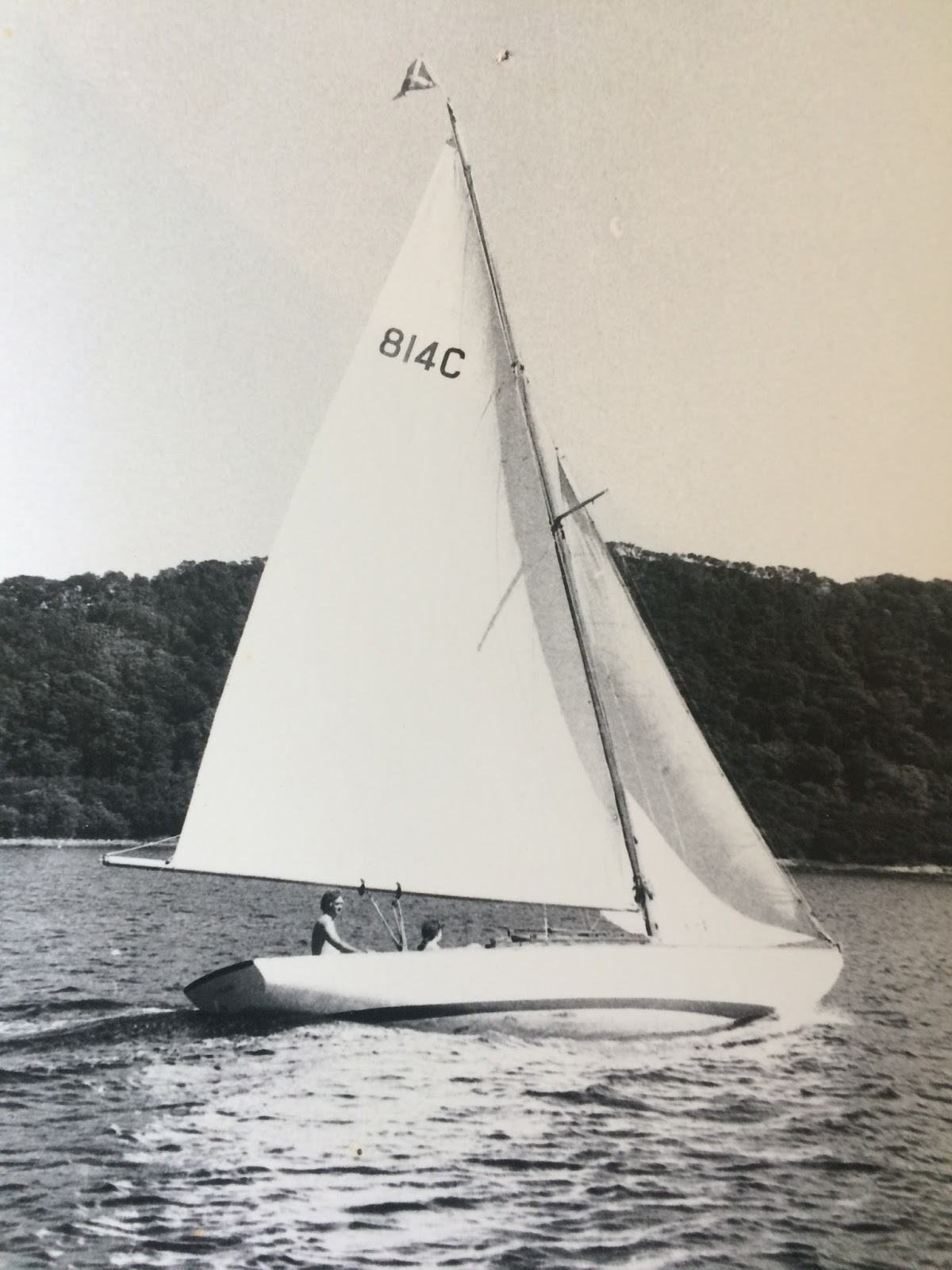
I bought Stroma, Scottish Islands Class One Design no 4, in September 1976, having had some experience of the class as an occasional crew on one or two of the other boats, notably Cara, on which I had crewed in Clyde Week and the Round Bute Race. I've written the history of the Class on another blog here: scottishislandsclass.blogspot.co.uk

What really sold Stroma to me was the trial sail. As I drove down from Glasgow to Ayr after work with my pal Peter the rain and wind were streaming across the bleak Fenwick Moor and we were certain that, although we had been asked to bring oilskins, we would be meeting the then owner John Thomson in a nice warm pub and talking about sailing over a few beers.

On arrival at Ayr Harbour we were met by John and a friend and immediately transferred to the yacht, sails ready to hoist, and were soon sailing out into the Firth in a stinking South westerly. This was a fairly standard excursion for the previous owner, who had recently taken part in the Southern Cross Race round Ailsa Craig in similar conditions. It was obvious that a yacht that looked after you in such conditions should not be allowed to pass through your hands.

The next twelve or so years were spent mainly discovering the rocks and reefs of the West coast initially from a mooring at the Brandystone in Oban, but also at Ardfern in its heighday. I won't write about the latter unless someone pays me a great deal.

After 1984 things sobered up a bit with a move to Kilmelford.


Waiting for the tide


These images were taken when I was trying to discover the source of an annoying leak at the foot of the stern post, which was temporarily fixed by injections of Lily the Pink's medicinal compound. 


the magician at work


Years later, during the restoration, I discovered that the stern post had some nasty vertical splits, probably suffered when we grounded hard on the bottom end of Lismore and had to bump over the reef to get off with the help of a stiff breeze. It wasn't entirely my fault, as my crew was the late John Stevenson, who had encouraged me to go inshore to cheat the tide that was flowing up against us like a river. John was an authority on the west coast, and the original model for the BBC's Sutherland's Law, where his career as a rural prosecutor was portrayed by Ian Cuthbertson. It's a pity that his knowledge just wasn't too good on the Lismore rock.

By 1989 Stroma was showing serious signs of old age, her fastenings loose and fittings periodically breaking free at critical moments. By this time I knew of her historical importance as one of the most famous racing fleet the Clyde has ever produced and still in original condition. As I didn't have the skills to restore her properly or the money to pay someone else the offer from the Scottish Maritime Museum to take her on and restore her was very attractive, and I sailed her down at the end of that Summer.

My contract with the Museum included a proposal for progressive restoration at its expense, on the basis that the uplift in value would go to them if the yacht was sold and also contained the following:

"The Museum shall be responsible for keeping the yacht insured..."

Sadly they forgot to do so, as I discovered when she sustained serious damage. A fishing boat coming past collided with her and squashed her, breaking several deck beams and splitting sections of beam shelf. This happened while she had been left afloat in Irvine harbour in winter, something I never imagined would happen.


The next couple of years were spent in fruitless negotiations, while the Museum tried to organise funds for the repairs. A major problem turned out to be my ownership. I was assured that if I donated her they would have no difficulty in restoring her to the highest standard, but by this time I was not convinced of their skills. (I do not wish to reflect at all on the present complement at SMM Irvine, none of whom was around twenty five years ago.)

In 1995 I finally recovered Stroma and had her brought to the shipyard at Renfrew, where I started a restoration that was to last for eight years. While I had doubts about my ability I had by this time met some pretty wonderful professionals who offered and indeed delivered advice and practical help quite gratuitously.

When she arrived Stroma was indeed in a sorry state. The Museum had attempted to protect the hull by bolting on large external rubbing strips, a curious form of sacrilege, but evidently added after both corners had been knocked off the stern. Much of the deck was rotten, as the fitted cover that I had provided had been left neatly folded in the cabin, while the boat was left out in the rain for a couple of years. The following images are better than words.


to be continued, here Chapter Two